

From Gold to the Next Generation: Simon Cass’ Journey Coaching Wheelchair Basketball
For Simon, coaching wheelchair basketball started somewhat unexpectedly. As an undergraduate in Victoria, Simon was playing and coaching able-bodied basketball when Jess Vliegenhart came into one of his classes to share her story of training for the London 2012 Paralympic Games. Jess had recently started a wheelchair basketball program at the college and was recruiting volunteers, and Simon jumped at the opportunity.
That one decision in 2011 marked the beginning of what would become a much longer journey.
More than a decade later, Simon is preparing for a third Canada Games with Team BC, following a gold-medal performance at the 2023 Games.
But if you ask him what has kept him coaching and involved in wheelchair basketball for all these years, the answer isn't medals, it’s the community. “It's smaller than you think,” Simon says. “Everyone supports each other. Even though the competition is steep, everyone is pulling in the same direction.”
That sense of community is one of the things that makes wheelchair basketball stand out for him. At the club level in particular, athletes with an enormous range of experience can share the same court. National team athletes are often training alongside someone who is trying wheelchair basketball for the first time, which in many sports, could be problematic. For Simon, that presents a coaching challenge he genuinely enjoys.
“You can't teach one way to do anything," he says. Every athlete brings different functional abilities, experiences and goals to the court, and finding the right approach for each person appeals to Simon's problem-solving side.
But solving every problem for an athlete isn't the goal either. Simon believes part of his job is stepping back and letting athletes create their own experience. And often, the community helps make that possible.
Experienced athletes understand how daunting it can be to be new to the sport. Even while working toward their own goals, they are often ready to lend a hand and make a new athlete feel welcome.
That combination of competitive basketball and community has become central to Simon’s approach to coaching.
.png)
Building On A Gold-Medal Foundation
Simon joined the Team BC program in 2013 and became head coach in 2015. At the 2019 Canada Games, Team BC finished sixth, the province's best result at the Games in nearly two decades.
Then came 2023.
After years of working with many of the same athletes, Team BC arrived at the Canada Games with a group Simon knew exceptionally well. Several of the athletes had been part of his coaching journey for close to a decade.
“It was quite a ride,” he says.
He shared that the road to the Games wasn't always straightforward. When COVID-19 disrupted training, the team had to find new ways to stay connected and keep improving. There were Zoom sessions, online cooperative puzzles, video work, and workouts taking place in backyards and basements. Simon got creative, and the athletes bought in. When they finally arrived at the 2023 Canada Games, that long-term investment paid off.
A Gold Medal Finish for Team BC
It was the first Canada Games gold medal in the program's history.
Simon is quick to be humble about it, but the achievement represents years of work and relationships built both on and off the court. Assistant coaches Marni and Tim Frick were also important mentors to Simon throughout that journey, helping him grow not only as a coach but as a person.
For Simon, one of the most meaningful parts of that experience came after the final game. He found himself wishing they had more time together. The athletes would age out. The tournament was over. The goal they had worked toward for years had been achieved. But the relationships remained. Even now, when members of that 2023 team see one another, they are excited to reconnect and share a positive relationship that extends far beyond the court.
.jpg)
The Journey to 2027
Now, Simon has returned as head coach, with a number of fresh faces on his squad, and they are working towards the same goal. The 2027 Canada Games are on the horizon, and a new Team BC is beginning to take shape.
Some familiar faces will be back. Elise Froese, who had only been with the team for a year at the 2023 Games, will return, along with Jeffer Ward. But many of the athletes from 2023 have aged out, creating space for the younger athletes from that team to step into new leadership roles.
The team's performance at Jr. Nationals in May gave the group an opportunity to see where they are and where they want to improve. Now, the focus is on building on that momentum, both on and off the court.
For Simon, that means developing as athletes while also becoming a team.
“It's such a cliché, but it really is the journey, not the destination,” he says. Of course, they're trying to win. The gold medal still matters. But Simon wants every athlete to have a meaningful experience along the way, regardless of how many baskets they score.
That means creating a team environment where athletes feel welcomed while still being challenged to compete and improve.
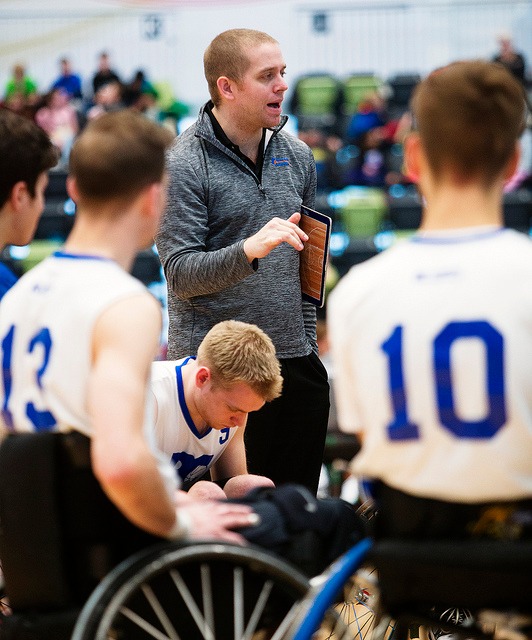
More Than What's on the Scoreboard
For Simon, one of the clearest measures of coaching success is what happens after the final whistle.
Canada Games can be an athlete's first experience with truly competitive, high-level sport. Simon wants that experience to leave athletes wanting more. "How many people want to stay involved in our sport?" he asks. Do they want to keep playing? Do they want to coach? Do they want to stay connected to wheelchair basketball? To Simon, those questions are the biggest measure of his success as a coach.
That belief comes from experience on both sides of it. Simon has seen firsthand how a negative sporting environment can leave a lasting impression on a young athlete. He also remembers his own positive experiences, even when the results weren't always what he wanted, and that contrast has shaped his approach. For him, enthusiasm is one of the most important qualities an athlete can bring to the gym. He wants young athletes to be excited to be there, excited to learn, excited to improve and excited to compete. That enthusiasm is contagious, and so is team chemistry.
He's watched what happens when it's missing, too. One of Simon's favourite lessons to share with athletes comes from his own playing days. He remembers a talented team that had plenty of ability but struggled with its team dynamic. Despite reaching provincial finals, the players spent much of their time waiting for the season to end.
Simon remembers his own playing years differently. His teams didn't always go as far, but he has overwhelmingly positive memories of those experiences. "You won't be successful if you don't have good team chemistry," he says. When a group is truly unified and everyone is working towards the same goal, the experience becomes something special. At Canada Games, athletes will spend more than a week together, from the moment they wake up until they go to bed, and that chemistry will really shape how they experience that week.
That shared experience can become more memorable than whatever ends up on the scoreboard.
Coaches are the Gatekeepers of the Sport Experience
That philosophy is particularly fitting during National Coaches Week, which runs September 14–20.
For Simon, the role of a coach extends far beyond teaching skills or drawing up plays.
“We are the gatekeepers of people's experience in sport,” he says.
Administrators, parents and organizations can all influence an athlete's experience, but coaches have a uniquely direct relationship with athletes. They are there during practices, competitions, successes and setbacks. They have the opportunity to shape how athletes experience sport and how they see themselves within it. There isn't necessarily much glory or money in most areas of coaching, Simon acknowledges. But there is something else that he feels makes it worth it: a coach gets the opportunity to build relationships and make a meaningful impact on athletes, both on the court and away from it. It can be thankless work. It can also be incredibly powerful.
With a background in sport management and kinesiology, Simon has spent years thinking about how to maximize an athlete's potential. But his objectives aren't limited to performance. He wants athletes to have a positive experience, too.
That is particularly important in wheelchair basketball, where creating an inclusive and competitive environment means understanding that every athlete may need something different to find success.
More than a decade after Jess Vliegenhart rolled into his undergraduate class and introduced him to the sport, Simon is still solving those problems.
Still building teams.
Still learning from athletes and fellow coaches.
And still showing up to the gym.
His message to anyone considering coaching is simple:
Please coach. We always need more coaches.
And perhaps that's the best reflection of what National Coaches Week is really about. Coaches may not always get the glory, but they have the opportunity to shape experiences that athletes can carry with them long after the game is over.


